
A lot of people assume that apprenticeships are for 16-year-olds only. It is easy to see why you would think this, as a lot of people do tend to go into an apprenticeship straight after they finish school. However, there are lots of apprenticeships for adults, and you are never too old to learn a new skill!

We know that it can be challenging to secure an apprenticeship as an adult. You may feel a bit overwhelmed, and you may struggle to set yourself apart from the younger applicants to ensure that you’re selected.
It’s not all doom and gloom, though; we promise! There is a way around this. So, with that in mind, read on to discover more about adult apprenticeships, the challenges that adults face, and how you can put the odds in your favour.
What does an apprenticeship entail?
Before we take a look at apprenticeships for adults over 40-years-old specifically, let’s take a look at apprenticeships in general and what they entail so that you can get a better understanding. If you are weighing up a mid-life change, it is also worth reading about what you can retrain to do at 40.
An apprenticeship is open to anyone who is not enrolled in full-time education. Apprenticeships are available in more than 170 industries, including fashion, finance, engineering, banking, aerospace, health, and much more.
Depending on the sector you get involved in, your current skills set, and your age, an apprenticeship can take anywhere from one to five years to complete. You will typically combine studying towards a qualification with working on the job.
You will need to work as an apprentice for 30 hours per week, yet no more than 40 hours.
Your employer will determine the structure of your training. Nevertheless, apprenticeships will tend to include the following:
- A detailed training plan
- Practical training on the job
- Support and mentoring throughout your apprenticeship
- Assessment testing at a training facility
- Theoretical study at a college
- Practical training on the job
The amount of money you earn as an apprentice will depend on a number of factors. This includes the sector you are working in, your existing qualifications, experience, and age, as well as the type of apprenticeship you apply for.
A lot of people believe that apprenticeships represent the best way for them to get their foot in the door of their chosen career because they enable them to learn on the job while getting a qualification. This sort of practical experience is not something you can gain by reading a textbook or listening to a lecturer.
Download your free information pack
Find out how you could train as a domestic gas engineer by downloading a free copy of our information pack.
Why is it more difficult to get an apprenticeship as an adult?
If you are over the age of 25-years-old, you may have assumed that there is no point in you applying for an apprenticeship. This is not the case. In fact, adult apprenticeships have become more popular in recent years, so this is something you should certainly explore in further detail.
However, we won’t sugarcoat things: it is more difficult to get an apprenticeship as an adult. No, this doesn’t mean that it is impossible or that it is not worth your time! Nevertheless, it does mean that you may experience a few hurdles or hear the word “no” a few times along the way.
Download your free information pack
Find out how you could train as a domestic gas and heat pump engineer with a free copy of our information pack.
Download information packSo, what is it about being an adult that makes it more difficult to secure an apprenticeship? Well, it mainly comes down to the cost. This is the fact that it is going to cost an employer more money to take on an adult apprentice.
The UK Government Guidelines reveal that employers need to pay apprentices a minimum wage of £8.00 (the Apprentice rate, which applies to apprentices aged under 19, or those aged 19 and over in the first year of their apprenticeship). After the first year (and once the apprentice is aged 19 or over), the standard National Minimum Wage / National Living Wage rate for their age applies.
For workers aged 21 and over the current rate is £12.71 per hour (the National Living Wage now applies from age 21, not 25).
Therefore, for someone starting their apprenticeship at the age of 16-years-old, an employer would pay the £8.00 Apprentice rate during the first year (or while the apprentice is under 19). After that, the apprentice moves onto the standard rate for their age – £10.85 for those aged 18 to 20, rising to the age 21 and over National Living Wage of £12.71 per hour.
It is purely economical, therefore, which can be a bit frustrating! Nevertheless, all hope is not lost. A lot of companies will have their own wage levels and they will pay above the minimum wage, so do keep that in mind.
There is also good news on training costs. For adult apprentices, the government funds 95% of the cost of an apprentice’s training, with small and non-levy-paying employers co-investing just 5% (within the funding band maximum); levy-paying employers fund training through their apprenticeship levy. From the 2026/27 academic year (starting August 2026), training is fully funded – with no 5% co-investment – for apprentices aged 16 to 24 at non-levy-paying small and medium-sized employers, and from October 2026 a payment of up to £2,000 is available to non-levy employers recruiting a new apprentice aged 16 to 24. Always check the current rates and rules on GOV.UK, as figures can change.
Last reviewed: June 2026. Wage rates correct as of 1 April 2026.
Consider a ‘fast track’ course
As mentioned in the introduction, it is not all doom and gloom. There are other options available to you that can help you to get an apprenticeship quickly. One of these options is to take a fast track course.
By doing this, you will get all of the qualifications you need to enter the career you are interested in. This means you essentially bypass the requirement for an apprenticeship. You’re going to get the training in a smaller chunk of time, which means you can be qualified quicker, and start earning more quicker.
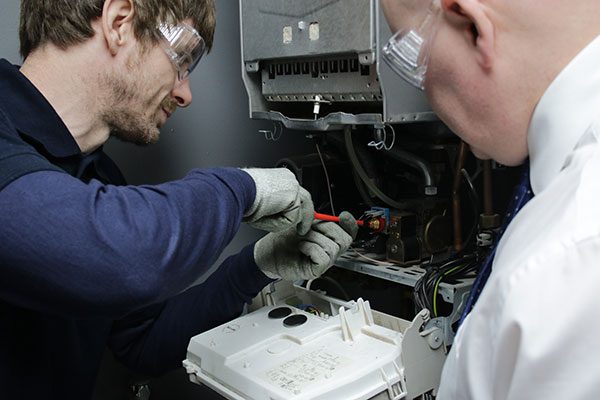
These courses are especially well thought of in certain industries, for example, in gas engineering. By taking a Gas Managed Learning Programme, you will cover everything you need to become fully qualified in just 25 weeks. This includes core practical and gas skills, as well as electrical safe isolation, unvented hot water storage systems, domestic gas fires, domestic gas cookers, domestic gas central heating boilers, combustion performance analysis, and much more!
Final words
So there you have it: an insight into apprenticeships for adults over 25-years-old. As you can see, there are options available to you, no matter your age. Taking a ‘fast track’ course is definitely one of the best ways to acquire the new skills you need and get your career on the right track. You are never too old to go for the career you have always wanted!
Download your free information pack
Find out how you could train as a domestic gas engineer by downloading a free copy of our information pack.
Become a qualified gas engineer
Our New Entrant Gas Engineer courses take you from beginner to Gas Safe registered, with hands-on training and the ACS qualifications employers look for.
Blog categories
Keep up to date with the latest news from
Skills training group.