
Emergency first aid training is the first type of training companies in low-risk fields tend to choose. Because it is a one-day course, it lets an employer train several people rather than rely on a single first aider, which is usually the most practical way to keep cover in place across shifts, holidays and sickness.
This contrasts with First Aid at Work (FAW), which is far more comprehensive but requires more company funds to send fewer employees.
Let’s look at why you would need first aid training for the workplace.
We’ll review what qualifications a certified first aider should have and what kind of first aid at work works for your office.
Last reviewed: September 2026 — checked against Resuscitation Council UK Guidelines 2025.
What Are the First Aid for Emergency?
A good first aid training course should cover the appropriate first aid at work depending on the industry and work environment involved.
After all, even self-employed individuals can get injured at work.
The goal of workplace first aid is the early assessment of injuries, treatment, and the conduct of appropriate first aid until emergency services arrive to provide adequate medical assistance.
This makes emergency first aid at work slightly different from more popular courses.
This is because emergency first aid is a course designed to determine and treat less serious casualties.
What Are the Responsibilities of First Aiders?
First aiders get their name because they are the first to respond to an evolving medical situation.
They are trained in practical skills needed to care for a casualty until they can be stabilized for transport.
There is no blanket rule that every workplace must have a qualified first aider. Under the Health and Safety (First-Aid) Regulations 1981 and HSE guidance L74, what you provide is decided by your first aid needs assessment. The minimum in any workplace is a suitably stocked first aid kit and an appointed person to take charge of the arrangements and call the emergency services — an appointed person does not need a first aid qualification. Where the assessment identifies greater risk, you put trained first aiders in place. Their responsibilities typically include:
- Performing cardiopulmonary resuscitation (CPR) on a casualty in cardiac arrest, and recognising a heart attack early so 999 is called straight away
- Use Automated External Defibrillators (AED)
- Casualty observation (vital signs, risk Assessment, and needs assessment)
- Controlling bleeding, including life-threatening bleeding where the needs assessment has identified that risk
- Placing stable patients in the Recovery Position until help arrives
- First aid (paediatric) for children
- Supporting a colleague in a mental health crisis until professional help arrives — since the 2024 revision of L74, employers must take account of employees’ mental health in the first aid needs assessment
A first aider can be anyone!
Successful candidates who undergo a First Aid at Work course have the knowledge and the temperament for dealing with a casualty and are always eager to help and support others.
When their training is completed, they have the resources to respond to incidents for the next three years.
What Are the Responsibilities of Emergency First Aiders?
Meanwhile, an emergency designated first aider is responsible for maintaining the health and safety of a workspace that’s not used to needing medical help.
These include offices, schools, and other places where injuries are uncommon.
Here are some of the common responsibilities that the first aider of this type must handle:
- Unresponsive patients with heart problems
- Controlling severe and life-threatening bleeding
- Helping a choking casualty — encourage coughing, then back blows and abdominal thrusts
- Aid workmates undergoing seizures
- Treating burns and electrical accidents
- Casualty reporting
Because of the lower chances of encountering an injured patient, this type of First Aid at Work course is much shorter than a traditional First Aid at Work course, which lasts about three days.
Successful candidates who complete such a course are oriented toward workplace-specific injuries and treatment.
This means knowing how to stop bleeding incidents, treat burns, and conduct cardiopulmonary resuscitation.
A first aider in this kind of role needs the confidence to step out of their day job and take charge of an incident, plus the awareness to notice a colleague struggling with their mental health as readily as one who is physically hurt.
They need to be able to reach for the aid kit, stabilize the casualty and prepare them for the eventual move to the hospital. They must also be aware of a workmate’s potentially life-threatening illness.
What Is the Difference Between First Aid and Emergency First Aid?
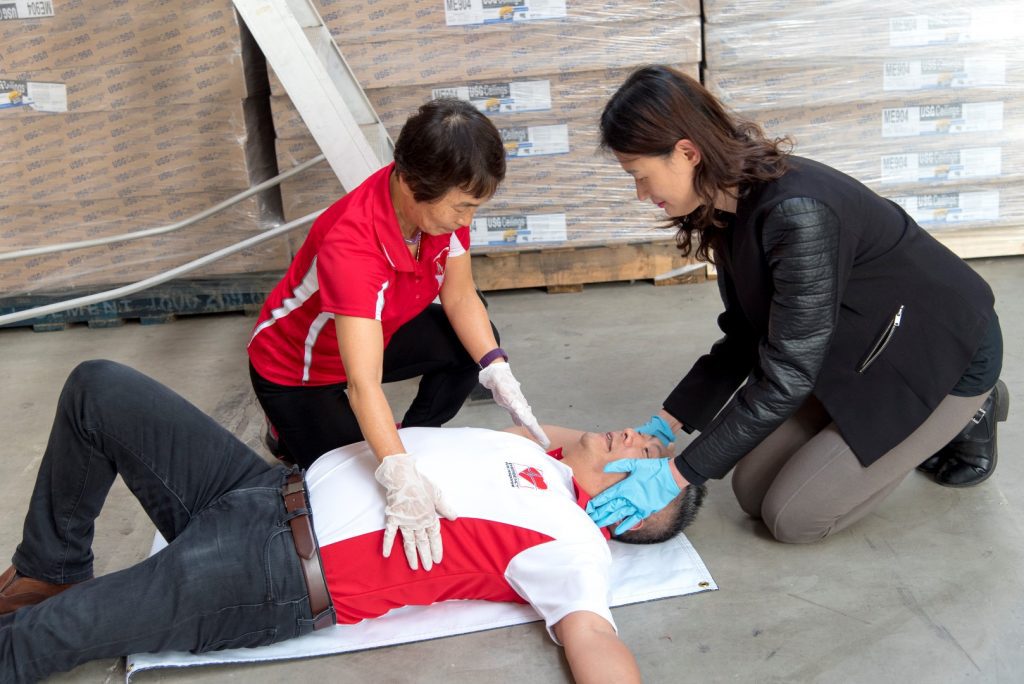
The difference between emergency first aid training and first aid at work is the likelihood of injuries in their respective workspaces. Both courses have plenty of overlapping skills.
The real issue comes down to how often they must be used.
Upon successful completion of each training course, a first aid practitioner is equipped to provide emergency medical care to a casualty who may have experienced heart problems or rough falls during their work day.
One of the main differences between the first and second courses is the length. The full First Aid at Work (FAW) course is typically three days long (a minimum of 18 hours of training) because it covers a wider range of injuries and illnesses.
The lower-risk Emergency First Aid at Work (EFAW) course usually lasts one day (a minimum of 6 hours of training). This is not enough time to cover every conceivable injury, just the basics. Both qualifications are valid for three years.
The length of training also affects the number of skills shared.
A traditional first aid course prepares one to provide almost every type of immediate aid available. These include CPR, bandaging, carries, burn treatment, and more.
Here is a more comprehensive aid list that shows the differences between the two kinds of training:
- First aid at work is designed for higher-stress workplaces, while EFAW is designed to give first aid in workspaces less prone to injuries
- FAW is designed to give more detailed first aid treatments such as poisoning, burns, chest and eye injuries, and more. EFAW is not.
- Both courses are designed to treat choking individuals, wounded individuals, and those in shock. They both treat minor injuries like cuts, nicks, and bruises.
Which First Aid Does Your Workplace Require?
A good workspace knows the appropriate first aid courses to send their workers to, depending on the work environment.
If you expect an employee to get an anaphylactic shock, you will need a practitioner trained in full first aid, which covers more comprehensive casualty treatment.
If your office needs someone to deal with cuts and bruises, you can do so with a lesser-trained first aid practitioner. This also allows you to train and equip more employees with the right first aid insights.
The law does not name a course. It requires first aid provision that is “adequate and appropriate in the circumstances”, so the deciding question is which course matches the hazards, headcount and layout your needs assessment has identified.
Every workplace needs a suitably stocked first aid kit and an appointed person as a minimum. Whether you also need trained first aiders, and how many, is a decision your needs assessment makes — there is no licence or register for workplace first aiders.
A multitude of lesser-prepared responders makes response quicker and keeps wounds from getting out of hand.
At the very least, having EFAW-instructed personnel ensures that nobody panics and everyone has the mindset of saving the patient until the ambulance can arrive.
What Changed in HSE Guidance L74 (2024 Revision)?
HSE’s First aid at work: Guidance on regulations (L74) is the document employers work from. It is now the third edition, published in 2013 and amended in 2018 and again in 2024. The 2024 amendments changed what a needs assessment has to take into account:
- Mental health is in scope. Employers must take account of their employees’ mental health when deciding what first aid to provide, not just physical injury and illness.
- “Life-threatening bleeding” replaced “catastrophic bleeding”. HSE also added guidance on what to do where you identify that risk, which can mean providing tourniquets and haemostatic dressings and training people to use them.
- Deciding what to provide was simplified. The 2024 revision streamlined the guidance on how employers reach that decision rather than adding new paperwork.
- Blended learning is accepted. L74 has recognised blended first aid training — online theory combined with face-to-face practical teaching and assessment — since the 2018 reissue, and that remains the position today.
Course content moved on separately. Training materials had to comply with the Resuscitation Council UK Guidelines 2025 from January 2026. The change workplace first aiders notice most is that you now call 999 for any unresponsive person before assessing breathing, put the phone on speaker, and let the ambulance call handler guide you. If your first aiders were certificated before 2026, their next requalification is where they will pick this up.
Conclusion
Many first aid courses are offered to reduce workplace injuries and allow the appointed person to save lives.
They train an emergency first aider to have the knowledge to face any casualty. It is best to call for medical help in a serious emergency when in doubt.
The first aider’s role is to render appropriate first aid, such as stopping the bleeding or operating the Automated External Defibrillator (AED).
Become a qualified gas engineer
Our New Entrant Gas Engineer courses take you from beginner to Gas Safe registered, with hands-on training and the ACS qualifications employers look for.
Blog categories
Keep up to date with the latest news from
Skills training group.