
18th Edition Wiring Regulations: What Are They and Why Are They Important?
In 2018, the Institution of Engineering and Technology (IET) released new regulations governing the erection and installation of electrical systems.
The 18th edition regs are designed to make electricity safer in the UK and harmonise existing electrical installations with European (CENELEC) standards.
The 18th Edition has been amended four times since then. The current version is BS 7671:2018+A4:2026 — the Amendment 4 edition, published by the IET and BSI on 15 April 2026 and known across the trade as the Orange Book.
Mastery of this qualification requires the candidate to show an understanding of the regulations and the proper safety procedures. This overview covers what you’ll need to know about the 18th edition.
Last reviewed: September 2026 — updated for BS 7671:2018+A4:2026.
18th Edition Wiring Regulations – Overview
Formally known as British Standard BS 7671: “Requirements for Electrical Installations. IET Wiring Regulations,” the 18th edition is more commonly known as “the wiring regs.”
These regulations have covered electrical installations and alterations since 1882 and are consistently being updated to provide industry-wide protection.
The 18th edition regulations apply to electrical wiring systems in commercial, industrial and domestic buildings.
These comprehensive guidelines also cover wiring installation in special zones like bathrooms, swimming pools, and fairgrounds.
The 18th Edition Amendments at a Glance
The 18th Edition was published on 2 July 2018 and came into effect on 1 January 2019. It has been amended four times since:
- Amendment 1:2020 — published on 1 February 2020. A limited amendment concerning Section 722 only (electric vehicle charging installations).
- Amendment 2:2022 — published on 28 March 2022, the “brown book”. A substantial amendment: arc fault detection devices, changes to Chapter 42 and Section 443, and the new Chapter 82 on prosumer’s low-voltage electrical installations.
- Amendment 3:2024 — issued as a free-to-download PDF “bolt-on” to the brown book. It covered arrangements for prosumer’s low-voltage electrical installations and introduced requirements for bidirectional protective devices (Regulation 530.3.201).
- Amendment 4:2026 — published on 15 April 2026, the “Orange Book”. The largest update since 2018.
There is a transition period. Until 15 October 2026 installers may work to either version, but from that date BS 7671:2018+A4:2026 is the only current standard, and the previous version (BS 7671:2018+A2:2022 plus the Amendment 3:2024 bolt-on and the May 2023 Corrigendum) is withdrawn.
For completeness: there is no 19th Edition. The IET has not announced a draft, a consultation or a timetable for one — Amendment 4 to the 18th Edition is the current standard.
What Is the Importance of the 18th Edition?
These new regulations are important to keep existing installations up-to-date and safe for the general public and any other electrician.
It’s vital to familiarise yourself with these guidelines if you’d like to work on electrical installations and install socket outlets safely.
Many agencies will typically only hire electricians with up-to-date knowledge of the existing guidelines.
Being familiar with these guidelines can also help anyone who wishes to register in a competent person scheme.
REMINDER: You are not cleared to work as an electrician by gaining an 18th-edition qualification.
Do All Electricians Need the 18th Edition?
It’s recommended that all practising electricians familiarise themselves with the current version of the regulations — BS 7671:2018+A4:2026 — by taking an appropriate 18th-edition training course.
If you’re an electrician, we recommend taking a training course to earn this qualification, but other allied professionals can take these courses, too, like electrical engineers and consultants.
If you already hold an earlier 18th Edition qualification and only need to get up to speed with what has changed, the shorter 18th Edition Amendment 4 update course covers that ground in a day.
Candidates who complete the 18th edition course will find it easier to find employers and secure work. This qualification is a worthwhile addition to any electrician’s credentials.
Do You Need to Do the 18th Edition Course?
Homeowners who wish to modify or maintain an on-site installation don’t need to take a course, but electricians are strongly advised to complete the full course.
Download your free information pack
Find out how you could train as a domestic gas and heat pump engineer with a free copy of our information pack.
Download information packProfessionals from other related trades, like contracts managers, can also earn this qualification by taking the relevant training.
Many 18th-edition modules are theory-based, but we suggest looking for courses that offer practical experience using the necessary equipment.
It’s highly recommended that any previously qualified electricians take this course to refresh and enhance their knowledge of electrical installations.
What Is the 18th Edition Exam Structure?
Examinees must take a final exam to prove understanding and familiarity with the current guidelines. The current qualification is the City & Guilds 2382-26, which replaced the 2382-22. The exam consists of 60 multiple-choice questions that must be completed within 2 hours.
The exam is an open-book test, so examinees may bring a hard copy of BS 7671 when they answer. Take the right one. That means BS 7671:2018+A4:2026 — the Orange Book. The blue (2018) and brown (A2:2022) editions do not contain the Amendment 4 content and cannot be used in a 2382-26 sitting. Check the cover before you travel.
In the event that test-takers feel unprepared to take the exam, they can take a mock exam. This can help them earn their qualification quickly. Make sure any mock you use has been updated for Amendment 4 — one written against the older book will point you at the wrong page numbers.
Don’t rely entirely on the book; remember to review properly before taking the exam. You can also prepare with online resources and exam-taking tips for an easier time.
What Are the 18th Edition Wiring Regulations?
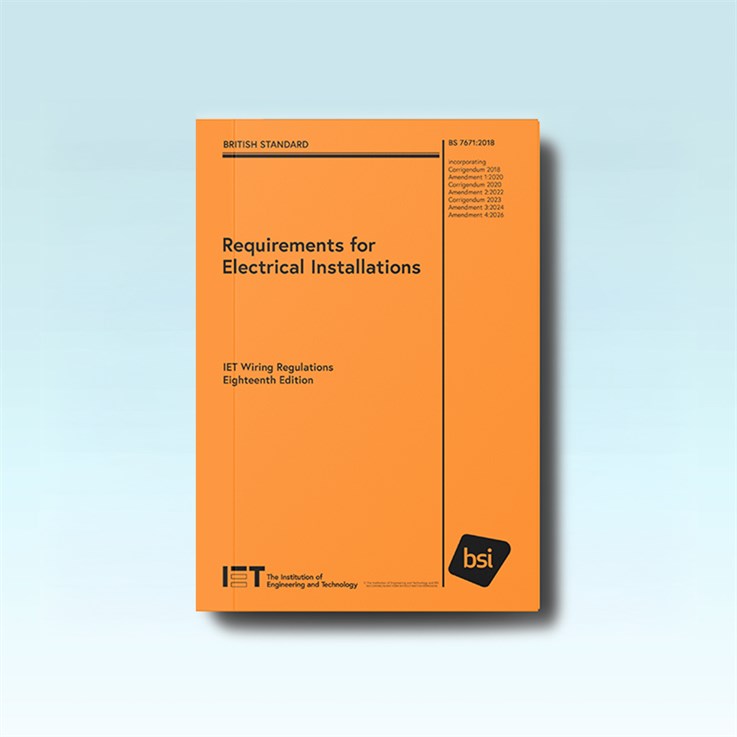
The 18th edition regs and a few changes supersede the previously-published 17th edition regulations.
Previously, the 17th edition had detailed changes concerning solar photovoltaic (PV) systems and RCDs, or Residual Current Devices.
Anyone planning to work in the electrical industry must familiarise themselves with the current IET Wiring Regulations. As of 15 April 2026 that is BS 7671:2018+A4:2026, and the previous version remains valid only until 15 October 2026.
These guidelines were introduced after the IET sought to harmonise UK electrical standards with that of CENELEC (European Committee for Electrotechnical Standardization.)
NOTE: BS 7671 is a non-statutory standard — it is not itself law. However, compliance with it is generally accepted as demonstrating compliance with the relevant statutory requirements, such as the Electricity at Work Regulations 1989 and the Building Regulations.
What Are the Key Changes in the 18th Edition?
Because the 18th edition outlines the current British standard for electrical installations, there are several important changes and new chapters compared to the previous edition — and four amendments have added more since 2018. Here are the key changes, grouped by when they arrived.
Introduced by the 18th Edition (2018)
- Chapter 41, Regulation 411.3.4: This regulation concerns additional protection by a 30 mA RCD. It requires all luminaires within domestic (household) premises to have additional protection by a 30 mA RCD when installed in an AC final circuit — which in practice means RCD protection for new lighting circuits, and for existing circuits that are significantly altered.
- Chapter 42, Regulation 421.1.7: This section of the regulations concerns protection against thermal effects such as fire, including fire caused by arc fault currents. In the 2018 edition, Regulation 421.1.7 recommended the installation of arc fault detection devices (AFDDs). That position changed under Amendment 2 — see below.
- Chapter 44: The 18th edition also includes guidelines on properly protecting buildings from transient overvoltage, commonly known as “spikes.” Spikes may be caused by either lightning strikes or normal switching operations. Surge protection devices (SPDs) may need to be fitted at consumer units or elsewhere in the installation, depending on the assessment made under Section 443.
- Chapter 52, Regulation 521.10.202: Chapter 52 covers the proper erection of wiring systems, especially in fire-prone areas. In the event of a fire, cables require adequate support to prevent premature collapse. This previously only concerned escape routes, but now the entire installation must have proper support.
- Section 722: Section 722 covers electric vehicle charging installations, including the use of a PME supply.
- Appendix 17: Appendix 17 includes recommendations for energy efficiency when designing and constructing new installations.
Added by Amendment 1:2020
- Section 722 rewritten: Amendment 1 concerned Section 722 only. Among other changes, Regulation 722.411.4.1 restricts the use of a PME earthing facility for charging outdoors unless one of five listed methods is used, and the fixed installation-height requirement for EV socket-outlets was removed.
Added by Amendment 2:2022
- AFDDs became a requirement, not a recommendation: Regulation 421.1.7 was redrafted. AFDDs conforming to BS EN 62606 are now required for single-phase AC final circuits supplying socket-outlets with a rated current not exceeding 32 A in higher-risk residential buildings, houses in multiple occupation (HMOs), purpose-built student accommodation and care homes. They remain recommended for other premises.
- Chapter 42 restructured: The BD1–BD4 external influence classifications were removed from Section 422 and replaced with the concept of “protected escape routes”, together with a requirement for the fire safety design of the building to be documented.
- Section 443 redrafted: Regulation 443.4 now determines the need for protection against transient overvoltages by reference to the consequences — serious injury to or loss of human life, or significant financial or data loss — with a risk assessment used in other cases.
- New Chapter 82: Prosumer’s low-voltage electrical installations, covering local generation, energy storage, energy management and the interface with the grid.
Added by Amendment 3:2024
- Bidirectional protective devices: Regulation 530.3.201 introduced requirements for protective devices used in circuits where current can flow in either direction — increasingly common in installations with solar PV and battery storage.
- Prosumer’s installations: Further arrangements for prosumer’s low-voltage electrical installations. Amendment 3 was issued as a free PDF “bolt-on” rather than a reprinted book, so a brown book on its own was never fully up to date.
Added by Amendment 4:2026
- Chapter 57: A new chapter covering stationary secondary batteries used for electrical storage and supply.
- Section 545: A new section on functional earthing and functional equipotential bonding for information and communication technology (ICT) equipment and systems.
- Section 716: A new section on Power over Ethernet (PoE) — included in BS 7671 for the first time.
- Section 710: A major revision of the requirements for medical locations, including a schedule of test results for recording the resistance of supplementary protective equipotential bonding conductors.
- Part 6 and Appendix 6: Changes to inspection and testing, the model forms, and how classification codes are applied. In particular, the observations section of the EICR is now split: C1 and C2 observations drive an “unsatisfactory” outcome, while C3 and FI (further investigation) observations do not. That reverses the previous position on FI codes.
Conclusion
The 18th edition IET wiring regulations are a vital qualification for anyone interested in working in the electrical industry or with electrical equipment.
Anyone who wishes to make alterations to an electrical installation or accommodate an electric vehicle must properly protect the wiring system.
Holding a current 18th-edition certificate demonstrates that your knowledge is up to date with BS 7671:2018+A4:2026. It is also what competent person schemes expect of their members — although the ability to self-certify your own work comes from scheme membership itself, not from the qualification alone.
If your certificate predates Amendment 4, the Amendment 4 update course is the efficient way to get current before the 15 October 2026 changeover.
Become a qualified gas engineer
Our New Entrant Gas Engineer courses take you from beginner to Gas Safe registered, with hands-on training and the ACS qualifications employers look for.
Blog categories
Keep up to date with the latest news from
Skills training group.